

Information last reviewed: October 27, 2026
Express Entry is one of Canada’s main pathways to permanent residence for skilled workers. If you have skilled work experience, language test results and the required qualifications, you may be eligible to apply for permanent residence through this system.
However, meeting the minimum requirements does not, by itself, mean that you will receive an invitation. You must first qualify for one of the programs managed through Express Entry. Your score and circumstances are then considered in invitation rounds.
This guide explains the differences between the programs, how points are calculated, the role of a job offer and Canadian work experience, category-based selection and the application process.
An important upcoming change: Immigration, Refugees and Citizenship Canada (IRCC) has announced changes to the way Canadian work experience and certain job offers are scored, effective November 3, 2026. At the review date of this article, these changes had not yet taken effect. They are explained in a separate section below.
What Is Express Entry?
Express Entry is an online system that manages permanent residence applications for skilled workers under three federal programs:
- Canadian Experience Class (CEC): for applicants with qualifying Canadian work experience.
- Federal Skilled Worker Program (FSW): for applicants with qualifying skilled work experience.
- Federal Skilled Trades Program (FST): for applicants with experience and qualifications in specified skilled trades.
Eligible applicants submit a profile and enter the Express Entry pool. They receive a score and are ranked under the Comprehensive Ranking System (CRS).
IRCC holds invitation rounds to invite eligible candidates to submit complete permanent residence applications.
Although these rounds are commonly called “draws,” selection is not random. The type of round, the candidate’s eligibility and their score affect the outcome.
Which Program Fits Your Profile?
| Program | Who is it for? | Main work experience requirement |
|---|---|---|
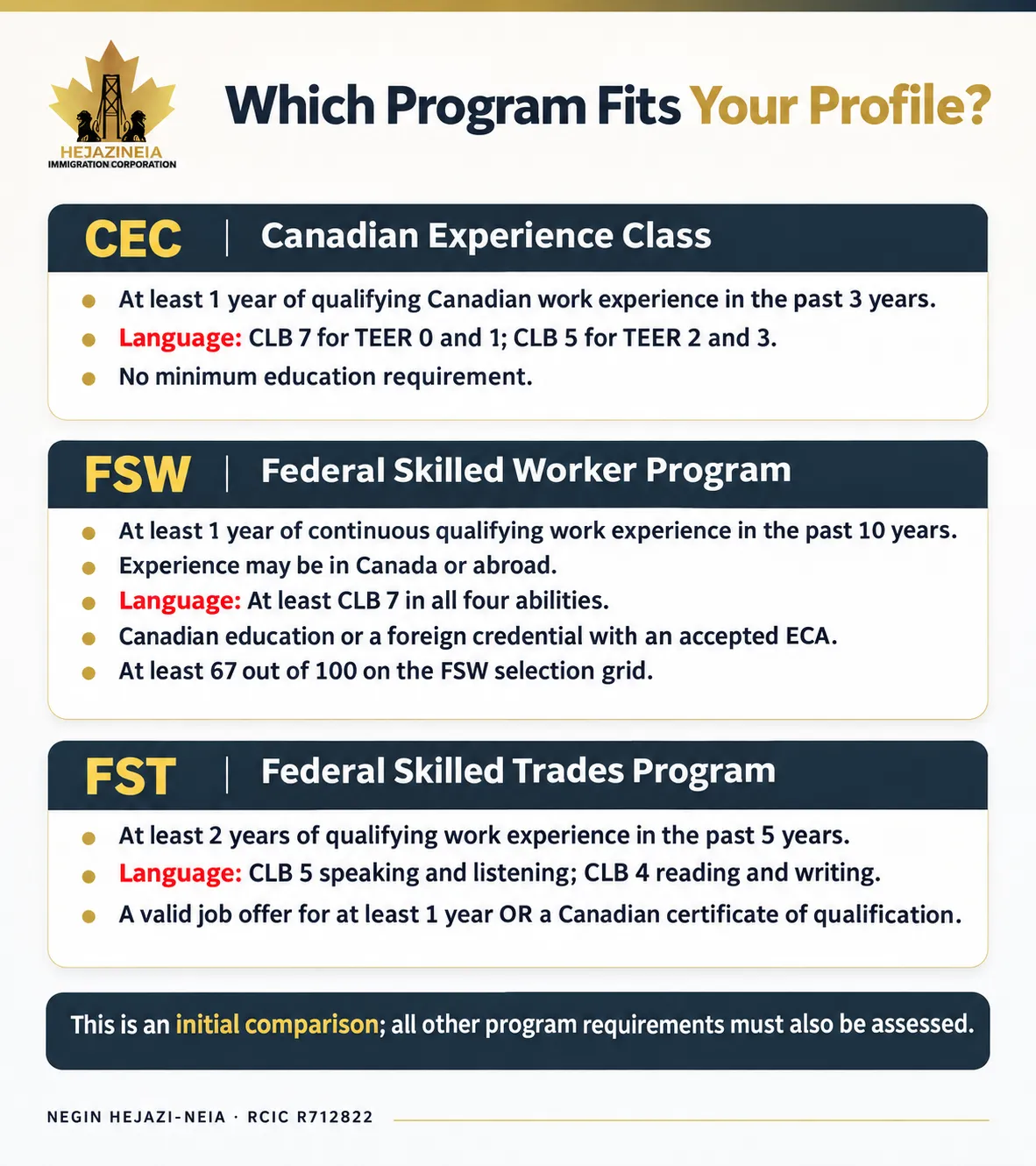
| Canadian Experience Class — CEC | Applicants with qualifying skilled work experience in Canada | At least one year within the past three years |
| Federal Skilled Worker Program — FSW | Applicants with skilled work experience in Canada or abroad | At least one continuous year within the past ten years |
| Federal Skilled Trades Program — FST | Applicants with experience in specified skilled trades | At least two years within the past five years |
This table provides an initial comparison. Language, education, the nature of the work experience and all other requirements of each program must also be assessed.
1. Canadian Experience Class (CEC)
This program is for applicants with qualifying skilled work experience in Canada.
Main work experience requirements
- At least one year of work experience, equivalent to 1,560 hours, in the three years before applying;
- Paid work in TEER 0, 1, 2 or 3 occupations;
- Work performed in Canada with legal authorization to work;
- Actual job duties that match the selected occupation code.
TEER classifies occupations according to the training, education, experience and responsibilities they require. Occupation codes are identified through Canada’s National Occupational Classification (NOC).
Working more than 30 hours per week does not shorten the required period of experience. Qualifying experience may be gained in more than one eligible job.
Work performed while studying full-time and self-employment generally do not count toward the minimum CEC work experience requirement. A specific exception exists for certain physicians providing publicly funded medical services.
Working outside Canada for a Canadian company does not, by itself, count as Canadian work experience.
CEC has no minimum education requirement. However, education can improve your competitive score.
2. Federal Skilled Worker Program (FSW)
This program may suit applicants whose skilled work experience was gained outside Canada, including in Iran.
Main requirements
- At least one continuous year of paid work experience, or its part-time equivalent, within the past ten years;
- Experience in the selected primary occupation, within TEER 0, 1, 2 or 3;
- A Canadian educational credential or a foreign credential supported by an accepted Educational Credential Assessment (ECA);
- Meeting the minimum language requirements and other program conditions;
- Scoring at least 67 out of 100 on the FSW selection grid.
The selection grid assesses language, education, work experience, age, arranged employment and adaptability.
The 67-point threshold is not a CRS score. It determines eligibility for FSW, while CRS determines your ranking in the Express Entry pool.
A job offer is not mandatory for every FSW applicant. Certain work experience gained during studies or through self-employment may also be considered under this program’s rules. CEC restrictions should not automatically be applied to FSW.
3. Federal Skilled Trades Program (FST)
This program is for people with experience in skilled trades specified in Canada’s occupational classification.
Main requirements
- At least two years of full-time work experience, or its part-time equivalent, within the past five years;
- Paid experience in an eligible skilled trade;
- Being qualified to practise the trade where the experience was gained;
- Meeting the minimum language requirements;
- A valid full-time job offer for at least one year, or a certificate of qualification issued by a competent Canadian authority.
A Certificate of Qualification is not the same as a trade training certificate from any educational institution.
FST has no minimum education requirement, but education may earn CRS points. Work experience gained while studying does not count toward this program’s minimum experience requirement.
The Federal Skilled Trades Program is different from category-based selection for trade occupations. One is an immigration program; the other is a way of selecting eligible candidates from the Express Entry pool.
What Language Results Do You Need?
The minimum language level depends on the program and, for CEC, the occupation’s TEER category:
| Program | Minimum language level |
|---|---|
| FSW | Level 7 in all four abilities |
| CEC for TEER 0 and 1 | Level 7 in all four abilities |
| CEC for TEER 2 and 3 | Level 5 in all four abilities |
| FST | Level 5 in speaking and listening; level 4 in reading and writing |
English results are assessed using the Canadian Language Benchmarks (CLB), while French results use the Niveaux de compétence linguistique canadiens (NCLC). These levels are not the same as IELTS band scores.
Accepted tests include:
- English: IELTS General Training, CELPIP-General and PTE Core
- French: TEF Canada and TCF Canada
Your test results must be valid and less than two years old when you submit your profile and when you submit your permanent residence application. IELTS Academic and IELTS One Skill Retake are not accepted for Express Entry.
Meeting the minimum language requirement does not guarantee a competitive score. Higher results may improve your ranking.
How Is Your CRS Score Calculated?
The Comprehensive Ranking System (CRS) is used to compare and rank Express Entry candidates.
The structure in effect at the review date of this article, before the November 3, 2026 changes, includes the following components:
| Component | Maximum points |
|---|---|
| Core factors such as age, education, language and Canadian work experience, without an accompanying spouse | 500 |
| Core factors with an accompanying spouse | 460 |
| Accompanying spouse factors | 40 |
| Skill transferability combinations, such as education and language | 100 |
| Additional points | 600 |
The current overall maximum is 1,200 points. Component maximums do not mean that every individual score can be added together without limits.
Additional points may include a provincial nomination, French-language ability, qualifying Canadian education or an eligible sibling.
There is no single fixed minimum score that guarantees an invitation across all rounds. Your score must be considered in relation to the type of round for which you qualify.
This scoring table should not be used for dates after November 3 without accounting for the changes.
What Role Does a Job Offer Currently Play?
On March 25, 2025, the previous 50 or 200 CRS points for job offers were removed. Until the new changes take effect, those former points should not be included in your calculation.
Official instructions removing the previous job offer points
However, a job offer may still matter for program eligibility. For example, a valid job offer is one of the options for meeting the FST requirements.
A job offer must be in writing and include details such as duties, wages, hours and employment conditions. Holding a work permit, including an open work permit, does not by itself mean that you have a valid job offer.
An open work permit allows you to work for different employers, subject to the conditions on the permit, rather than restricting you to one specific employer.
Changes Announced for November 3, 2026
New Points for Labour Market Integration
According to IRCC’s announcement, a new factor called Labour Market Integration will be introduced. This component will compare the points available under two options:
- Canadian work experience, including points for its duration and additional points for qualifying high-wage occupations;
- A qualifying job offer in a high-wage occupation.
The higher-scoring option will apply. The two options are not added together.
Additional Points for Canadian Work Experience in High-Wage Occupations
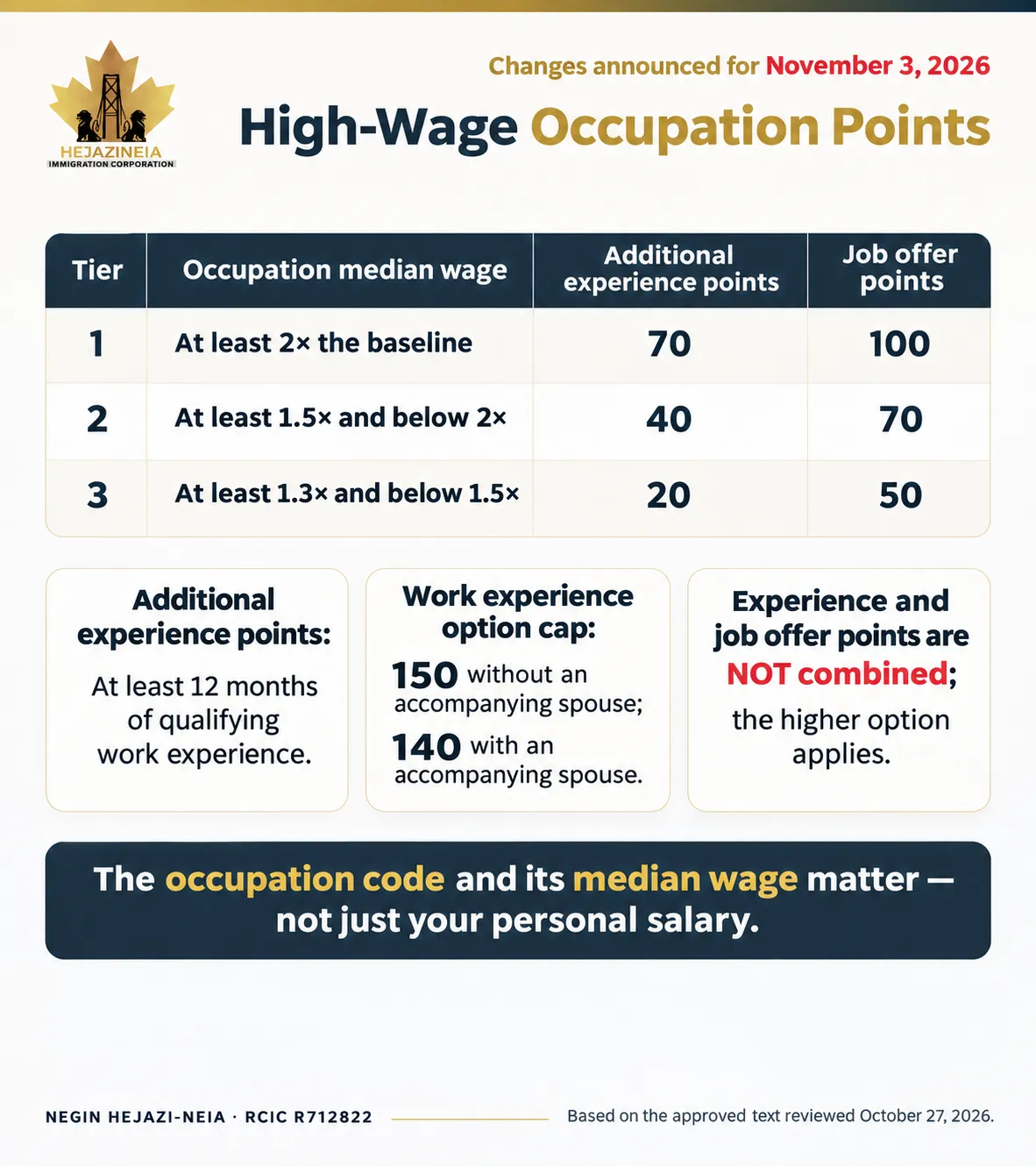
For at least 12 months of qualifying experience, the additional points depend on the occupation’s wage tier:
| Occupation median wage relative to IRCC’s specified baseline | Additional points |
|---|---|
| At least twice the baseline | 70 |
| At least 1.5 times the baseline, without qualifying for the higher tier | 40 |
| At least 1.3 times the baseline, without qualifying for the higher tier | 20 |
The announced maximum for the Canadian work experience option, including points for the duration of experience, is 150 points without an accompanying spouse and 140 points with an accompanying spouse.
High-wage status is determined by the occupation code and the occupation’s median wage, not simply by your personal salary.
Official details of work experience and scoring changes
Qualifying Job Offer Points from November 3
| High-wage occupation tier | Job offer points |
|---|---|
| At least twice the median wage baseline | 100 |
| At least 1.5 times and less than twice the baseline | 70 |
| At least 1.3 times and less than 1.5 times the baseline | 50 |
Not every job offer will earn points. The offer must meet both the Express Entry requirements and the high-wage occupation requirements.
According to IRCC’s announcement, Labour Market Impact Assessment (LMIA) requirements will change for qualifying job offers used under this framework. This does not mean that LMIA requirements are being removed from all work permit pathways.
The genuineness of the offer, the employer’s operations and ability to fulfil its commitments, and the applicant’s qualifications will still be assessed. A job offer may be valid for program eligibility without earning the new job offer points.
Official IRCC explanation of job offers and high-wage occupations
If You Already Have a Profile
IRCC has announced that existing profiles will be rescored after the changes take effect. This process may take up to two weeks, during which invitation rounds may be paused.
Your job offer, work experience and other profile information must be accurate and up to date. The announced pause should not be interpreted as a permanent closure of Express Entry.
What Are Category-Based Draws?
These rounds limit selection to candidates with a specific characteristic, such as French-language ability or particular occupational experience. Candidates must still qualify for one of the three federal programs and are ranked using CRS.
The announced categories include:
- French-language proficiency;
- Healthcare and social services occupations;
- Science, technology, engineering and mathematics (STEM) occupations;
- Trade occupations;
- Education occupations;
- Transport occupations;
- Physicians with Canadian work experience;
- Senior managers with Canadian work experience;
- Researchers with Canadian work experience;
- Eligible skilled military recruits.
The French-language category requires at least NCLC 7 in all four abilities. The general occupational categories above typically require 12 months of experience within the past three years in a listed occupation. The experience may be gained in Canada or abroad and may be non-continuous.
For the physician, senior manager and researcher categories, the experience must have been gained in Canada.
The military pathway has specific service, recruitment and education requirements.
A similar job title is not enough. The NOC code and the instructions for the particular round are decisive. Qualifying for a category does not guarantee an invitation.
Latest Express Entry Invitation Rounds
Status reviewed on October 27, 2026
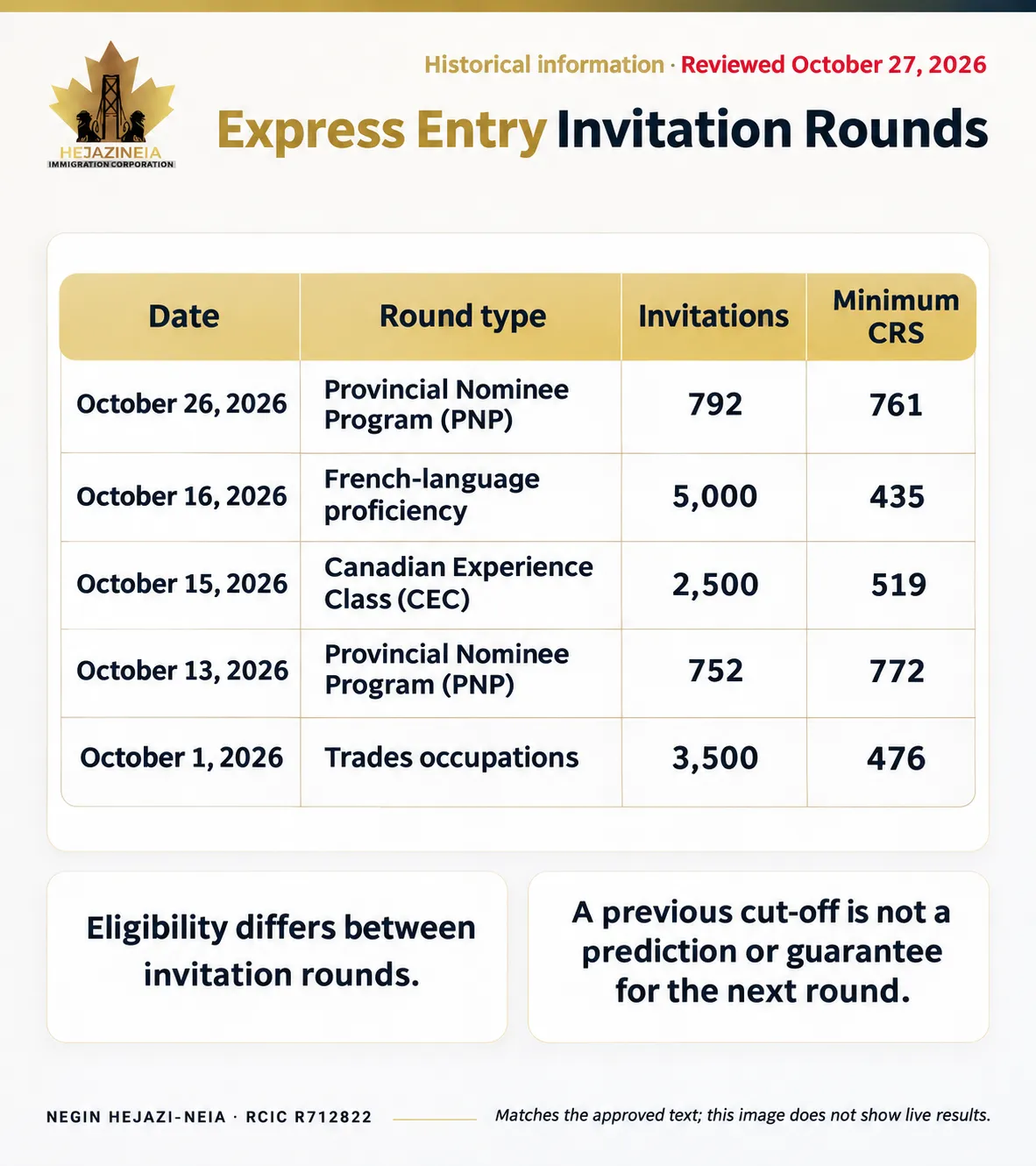
| Date | Round type | Invitations | Minimum CRS |
|---|---|---|---|
| October 26, 2026 | Provincial Nominee Program — PNP | 792 | 761 |
| October 16, 2026 | French-language proficiency | 5,000 | 435 |
| October 15, 2026 | Canadian Experience Class — CEC | 2,500 | 519 |
| October 13, 2026 | Provincial Nominee Program — PNP | 752 | 772 |
| October 1, 2026 | Trade occupations category | 3,500 | 476 |
These figures were taken from IRCC’s official invitation round data.
How Should You Interpret This Table?
Scores from different types of rounds should not be compared directly because the candidates’ eligibility conditions are not the same.
When several candidates have the same score at the cut-off, the tie-breaking rule and the time their profiles were submitted also matter. A round’s minimum score is not a promise or prediction of the next round’s cut-off.
Official explanation of the selection process
How Is Express Entry Connected to Provincial Nominee Programs?
Some Provincial Nominee Program (PNP) streams are linked to Express Entry. Accepting a valid nomination through these streams can provide 600 additional CRS points.
However, registering an Expression of Interest (EOI), receiving a provincial Notification of Interest (NOI) and receiving a Provincial Nomination are not the same stage. Nomination points are applied after completing the relevant process and accepting the nomination.
Not every provincial stream is connected to Express Entry. To learn about the different pathways, visit our Provincial Nominee Programs page.
Do You Need Proof of Funds?
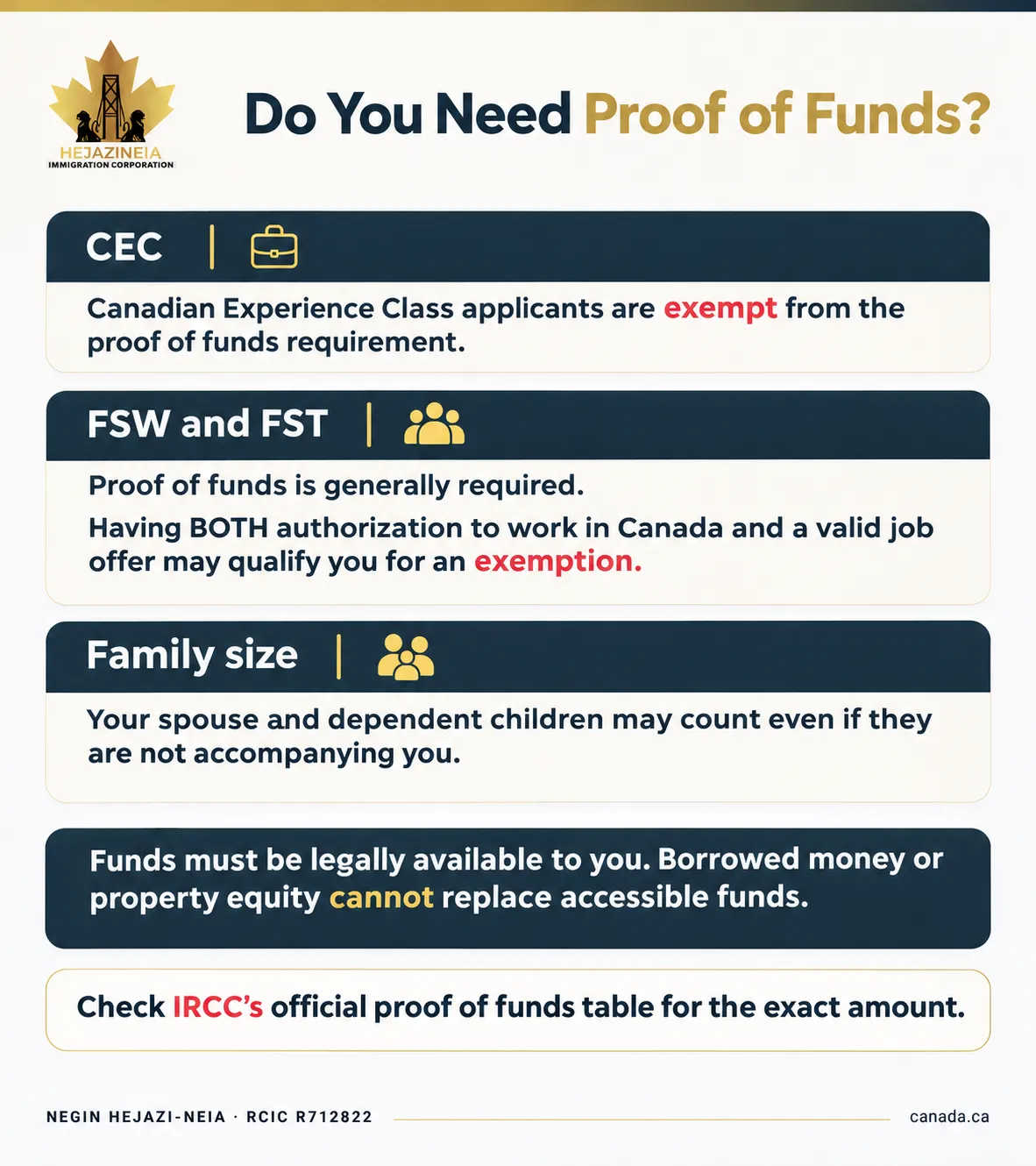
Proof of funds is generally required for FSW and FST. CEC applicants are exempt. For FSW and FST, having both legal authorization to work in Canada and a valid job offer may also qualify you for an exemption.
The required amount depends on family size. Your spouse and dependent children may count even if they are not accompanying you.
The money must be legally available to you. Borrowed money or property equity cannot replace accessible funds.
To avoid relying on an outdated amount, check the exact requirement in IRCC’s official proof of funds table.
Express Entry Application Steps
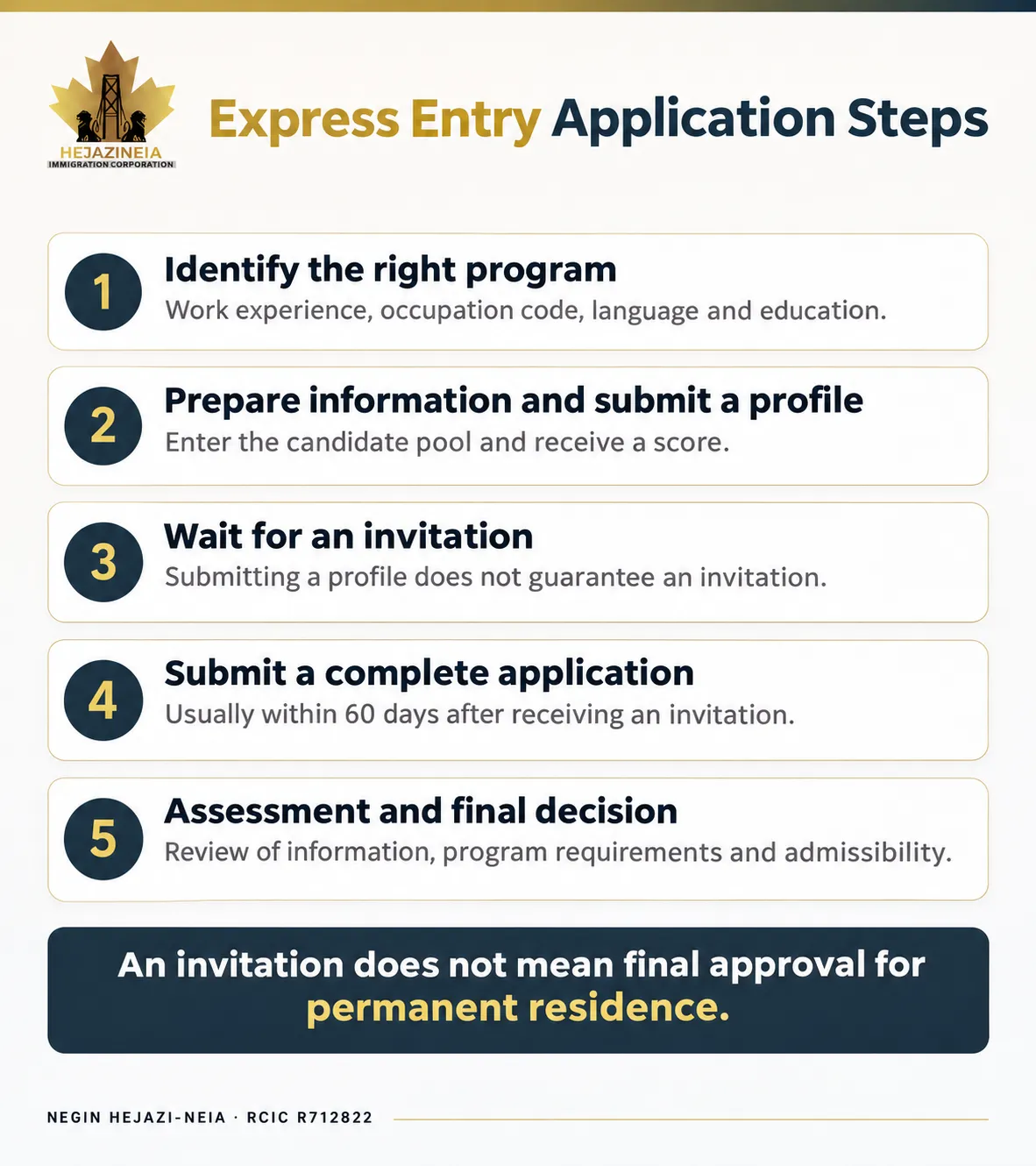
1. Identify the Right Program
Your work experience, occupation code, language ability and education are assessed to determine whether you meet the CEC, FSW or FST requirements.
2. Prepare Your Information and Submit a Profile
Your information must be accurate and supported by evidence. Once your profile is accepted, you enter the candidate pool and receive a score. Changes such as new language results or additional work experience must be recorded in your profile.
Guide to creating and updating a profile
3. Wait for an Invitation
Submitting a profile does not guarantee an invitation. If you are not invited within 12 months, your profile expires. To remain in the pool, you must meet the requirements for submitting a new profile.
4. Submit a Complete Application
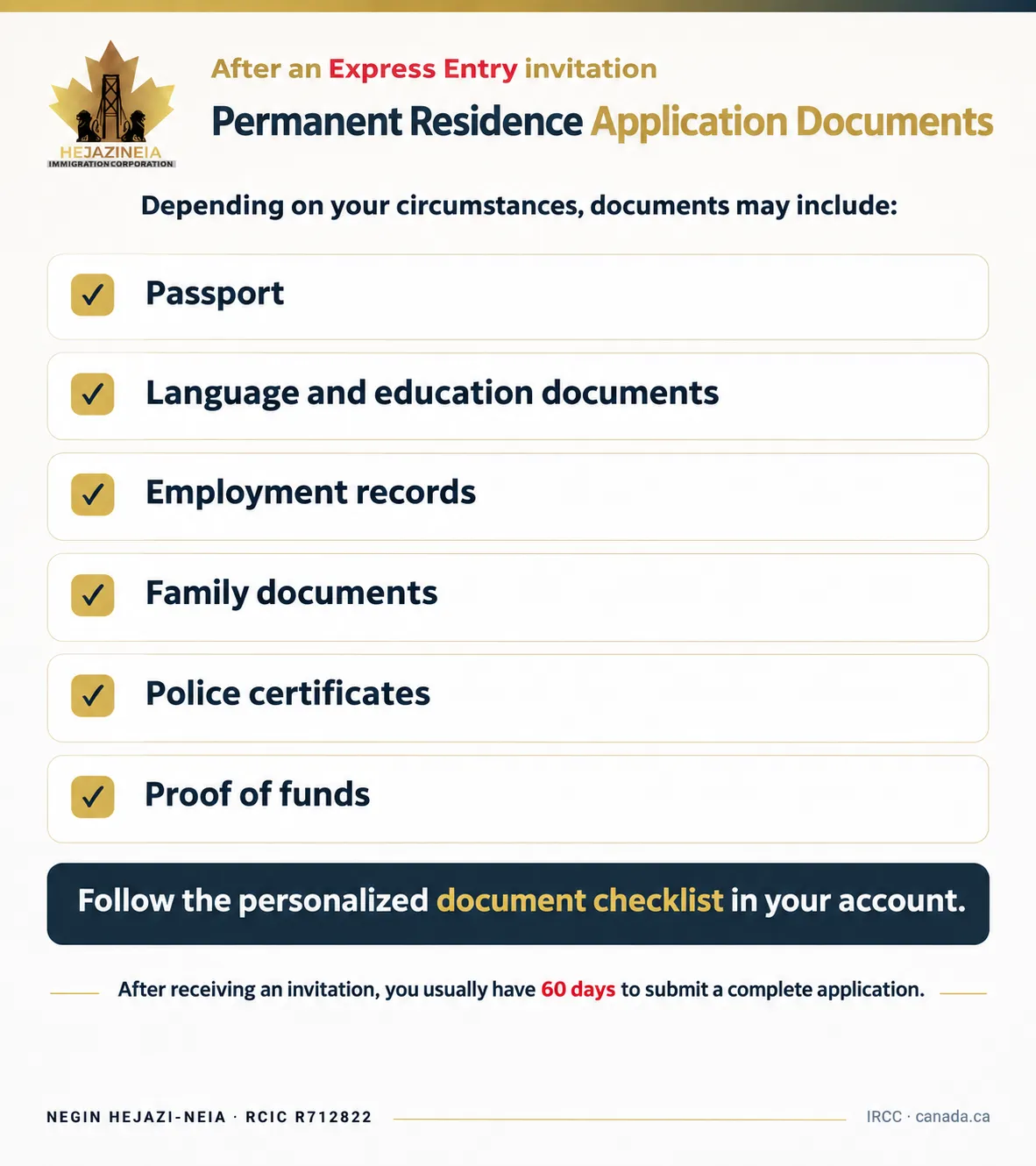
After receiving an Invitation to Apply (ITA) for permanent residence, you usually have 60 days to submit your complete application.
Depending on your circumstances, documents may include your passport, language and education documents, employment records, family documents, police certificates and proof of funds. The personalized checklist in your account determines what you must submit.
5. Assessment and Final Decision
IRCC assesses the accuracy of your information, program eligibility and admissibility. Receiving an invitation does not mean final approval for permanent residence.
Official permanent residence application guide
What Matters in an Initial Assessment of Your Case?
To make an informed decision, we need a complete picture of your circumstances:
- Do you meet the minimum requirements of one of the three programs?
- What is your CRS score based on information you can document?
- Do you qualify for a selection category?
- How exactly do your job offer and Canadian work experience affect your eligibility and score?
- Is there a relevant provincial pathway?
- Which documents are missing or approaching expiry?
- How will the announced changes affect your score calculation?
The goal is to choose a pathway that fits your actual circumstances and prepare an accurate application.
To discuss your eligibility, book a consultation with Hejazineia Immigration or call +1 778 869 4566.
This article provides general guidance. Each application is assessed under the rules in effect when the application is made and the evidence submitted for that case.